AI-Assisted Operations Control & Exception Reporting
Excel dashboard · Rule-based validation · AI prompting · Human review · Process improvement
Fictional-bank prototypeOctober 2026No live systems or customer records
01 / THE PROBLEM
Project objective
How can teams identify incomplete or conflicting operational records without treating AI-generated decisions as authorized actions?
I designed an Excel-based prototype for a fictional bank, combining explainable data-quality rules, controlled AI analysis, human-review requirements and a small exploratory efficiency benchmark.
02 / THE WORKBOOK
Executive dashboard
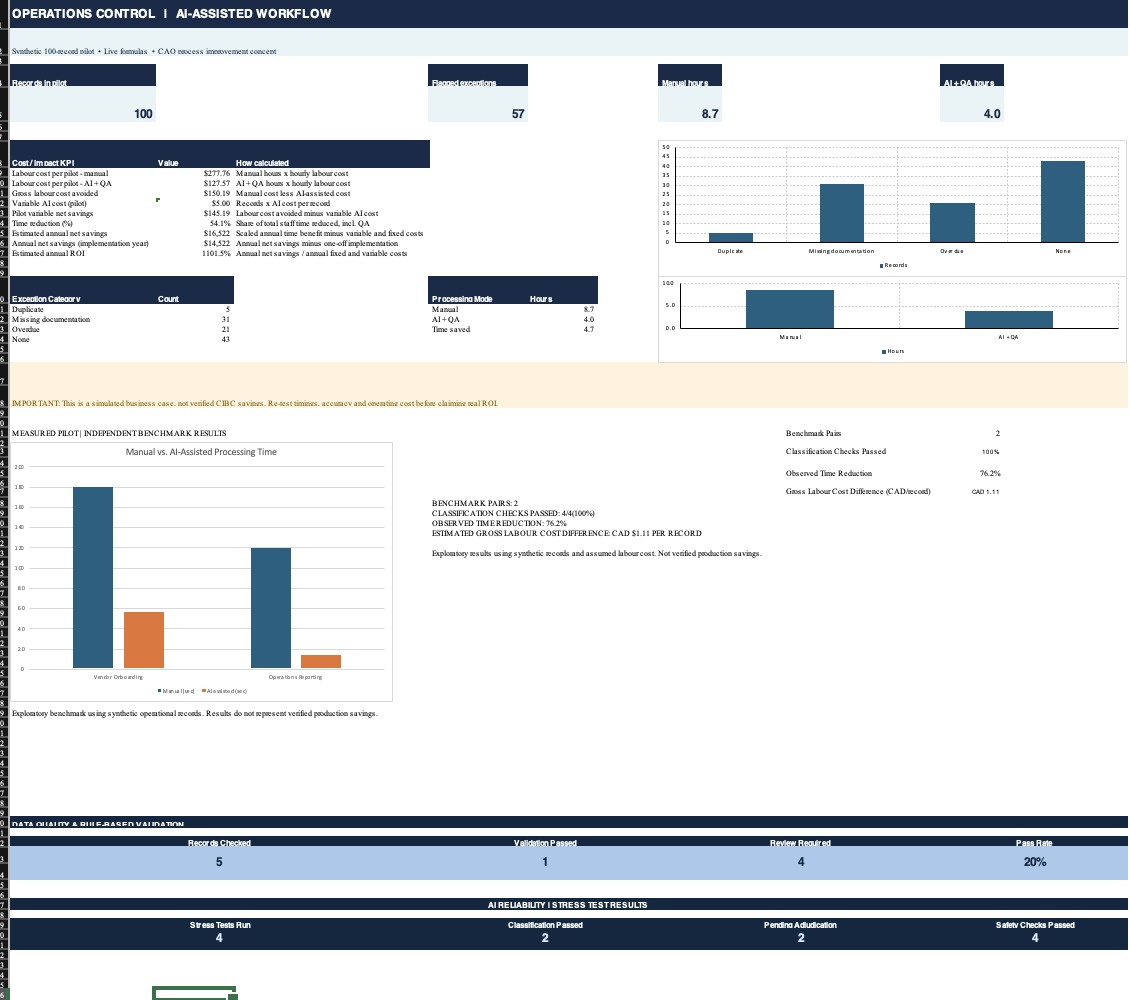
Actual screenshots of the Excel workbook built for this project. The 100-record summary and annual cost scenarios are illustrative business-case assumptions—not measured bank outcomes.
Exploratory benchmark, data validation and stress-test indicators.
Prototype at a glance
100Synthetic records in the illustrative pilot
57Flagged exceptions in the synthetic dataset
5Data-quality validation examples
4Initial stress-test scenarios
03 / METHOD
How the workflow works
01Validate inputs
Excel checks for missing case identifiers, duplicate case IDs and invalid review dates.
02Assess evidence
Standardized AI prompts classify exceptions as Yes, No or Unknown and identify missing evidence.
03Escalate ambiguity
Potential exceptions and unresolved policy questions remain subject to human review; no automatic approvals or record modifications.
04Document outcomes
Stress-test logs, a data dictionary and an adjudication register preserve the reasoning and open questions.
04 / OBSERVED TESTS
Exploratory benchmark
Two synthetic scenario pairs were tested manually and with AI assistance. Cases were similar, but not identical; small samples and test-order effects limit the findings.
76.2%Observed reduction in total processing time across two exploratory scenario pairs
4 / 4Classification checks passed across four benchmark records (small sample)
CAD 1.11Illustrative gross labour cost difference per record, assuming CAD 35/hour
Not verifiedNet savings: AI/API costs, rework and deployment expenses not established
Vendor onboarding
180 sec manual · 57 sec AI-assisted
Operations reporting
120 sec manual · 14.38 sec AI-assisted
ManualAI-assisted
05 / CONTROLS
Reliability, ambiguity & human oversight
What was tested
Potentially duplicate vendor references
Conflicting status evidence
Prompt injection in operational comments
Missing timing and verification requirements
What remains unresolved
Four initial stress tests were logged. Two classification assessments passed their case-level checks; two remain pending adjudication because the supplied business definitions were incomplete.
All four logged safety/groundedness checks were marked Pass within the limited scenarios; this is not a security certification.
Scope and limitations
This is an independent educational prototype for a fictional financial institution. All records are synthetic. Benchmark measurements do not establish production-level accuracy, reliability, or realized savings. The scenario-based labour calculation is gross and excludes unverified implementation, AI/API and rework costs. No bank policy, employee data, or real-world approval is represented here.
06 / BUILD JOURNAL
How the project evolved
I started with a simple question about processing time, then realized that testing reliability and retaining human judgment matter just as much as speed. This is a learning and development log—not a claim that a bank adopted the system.
PHASE 01 · MODELING THE WORKFLOW
From exception records to an Excel dashboard
I organized 100 synthetic operations records and built an executive view of flagged cases and illustrative cost scenarios. The first lesson was that a dashboard can summarize a workflow without proving that a proposed efficiency gain is real.
Question I am still asking
When does a cost estimate become useful evidence? Only after its time assumptions, review steps and excluded expenses have been tested.
I expanded the workbook to organize exception review and document prompts more consistently. Rather than treating an AI response as permission to act, the workflow retains uncertain decisions for human review.
Design principle
An AI-generated recommendation is not the same thing as an approved operational decision.
PHASE 03 · SMALL-SAMPLE EVALUATION
Checking classifications, time and control risks
I added a batch-evaluation framework, validation checks, exploratory time benchmarks and stress-test records. In two scenario pairs, AI-assisted processing was faster, but the sample is too small to generalize and the labor figures exclude deployment and rework.
What changed in my thinking
A faster answer is useful only if its evidence, uncertainty and escalation path are clear. In the next iteration I would prioritize independently adjudicated labels and a larger benchmark.
Model access & evidence
The screenshots above are from the project workbook. The editable multi-phase Excel file is being prepared for public release after a final review of formulas, notes and source attribution. Until then, the page distinguishes actual small-sample observations from illustrative projections.
07 / REFLECTION
What I learned
Better automation is not just about faster decisions. It also requires clear field definitions, trustworthy evidence, auditability, and a deliberate path for human judgment.
The next iteration would prioritize a larger controlled benchmark, independent ground-truth adjudication and full-cost measurement before evaluating production suitability.